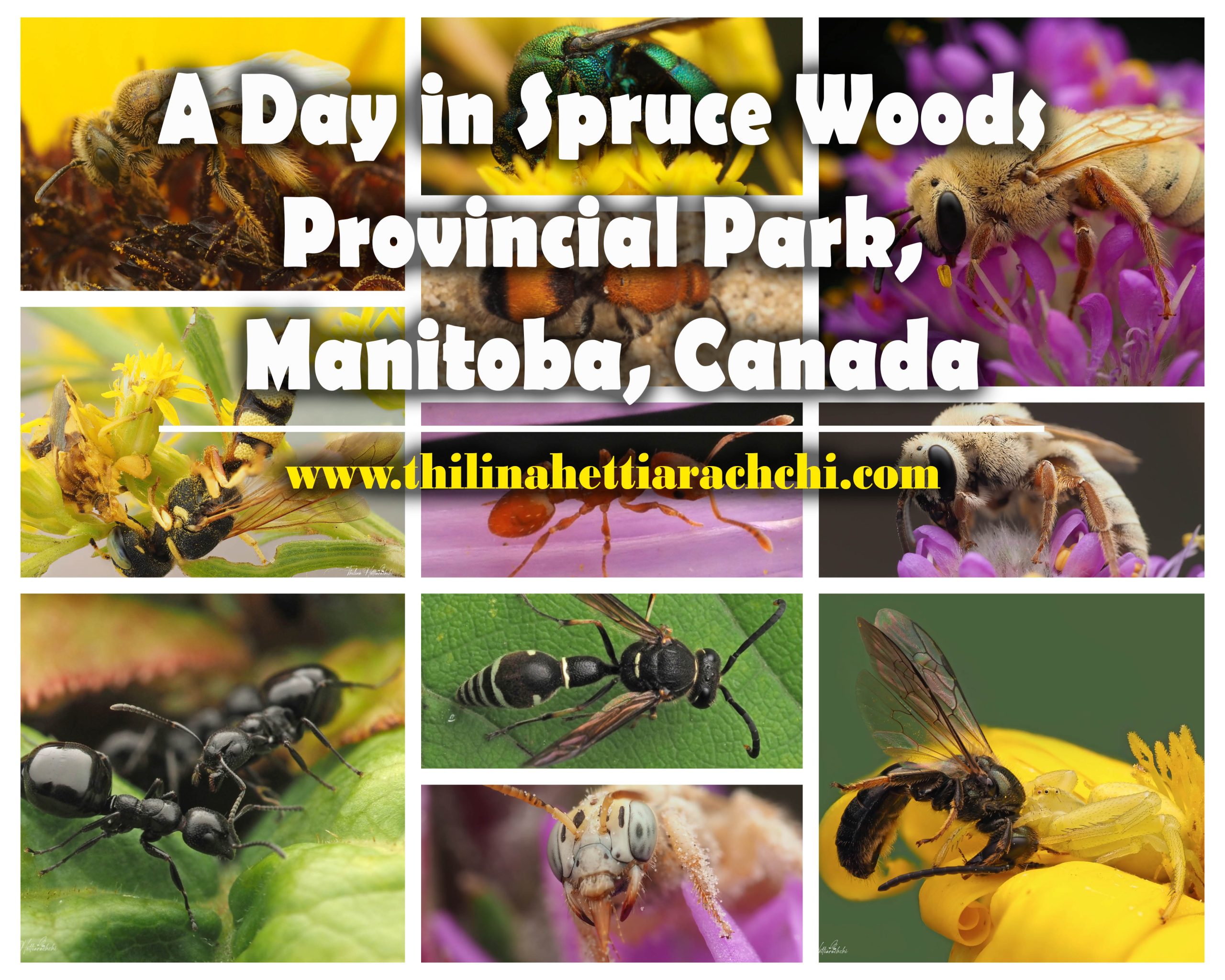
Exploring nature always promises exciting discoveries. As an individual originally from the tropical island of Sri Lanka, my journey to Canada for higher studies (now nearing its three-year mark) has presented me with opportunities to explore several regions of the country. Each expedition introduces me to landscapes and ecosystems new and exciting to me. As a taxonomist with a special interest in bees, and a passionate macro-photographer, my summers are typically spent hunting for insects, so when the chance of heading to Spruce Woods Provincial Park (49.659, -99.271) suddenly popped up, I was all in.

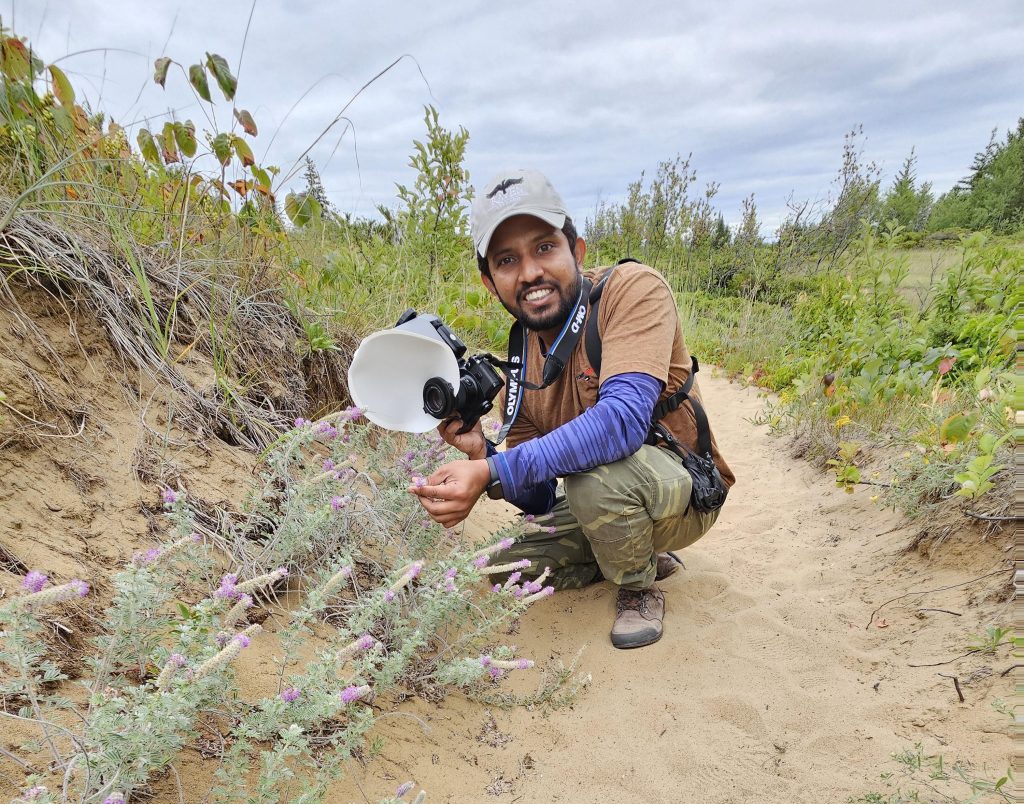
On July 28, 2023, I and my adventurous companions—Dr. Robert Wrigley (retired ecologist and former Museum Director at the Manitoba Museum in Winnipeg) and Jim Reimer (a skilled taxidermist and photographer)—embarked on an unforgettable expedition to Spruce Woods Provincial Park. Situated in south-central Manitoba, the park boasts the Spirit Sands (also known as the Bald Head Hills or the Carberry Dunes), a desert-like area featuring towering sand dunes reaching up to 30 metres high above the prairie. These inland dunes are a unique habitat for plants (e.g., two species of cacti) and animals in the region, making it a must-visit destination for nature enthusiasts in Manitoba.
I was immediately captivated by the diverse array of sights that greeted me. As we passed along winding paths through aspen-oak-white spruce forest and mixed-grass prairie, I documented 16 hymenopterans through the lens of my camera. To capture all these macro shots, I used an Olympus OMD EM1 Mark II camera body paired with a Zuiko 60 mm macro-lens, enhanced by the Raynox DCR 250 macro-converter. To illuminate my subjects with precision and depth, I employed the Godax V350o flash, complemented by a diffuser to soften and diffuse the light, ensuring optimal lighting conditions for capturing detailed and vibrant images.
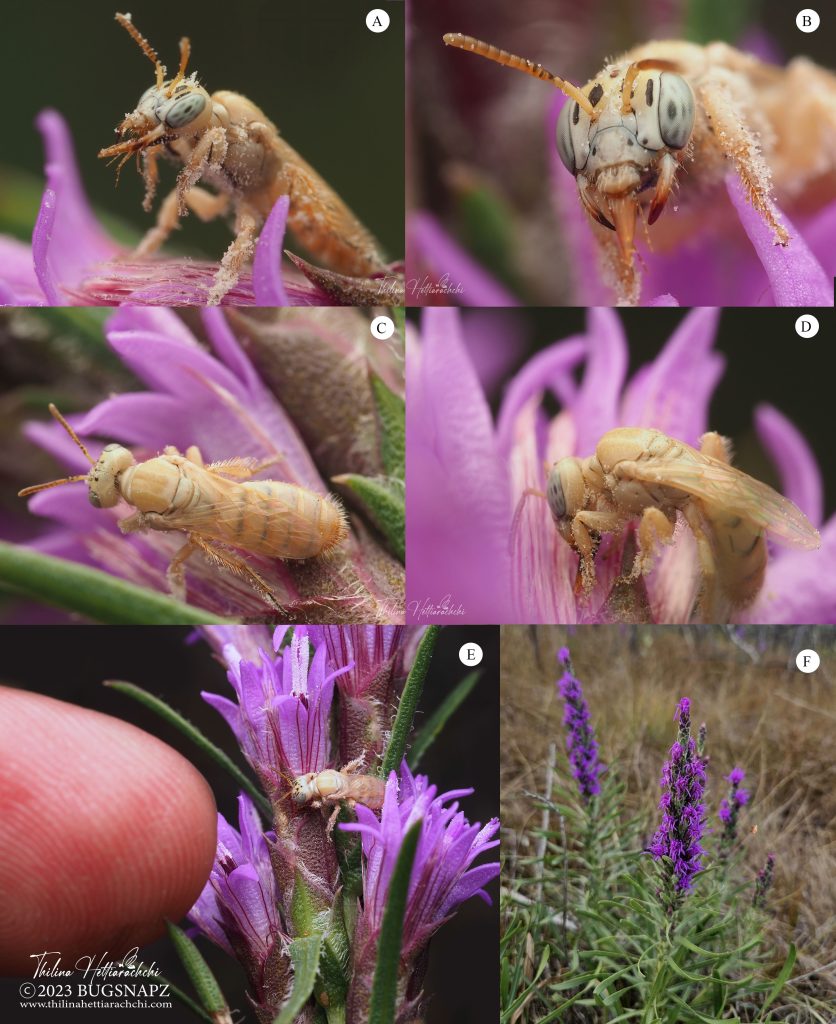
Among the initial discoveries was a diminutive bee measuring a mere 6 mm in size, identified as all-pale Perdita, Perdita perpallida Cockerell, 1901 (Andrenidae). Considered a specialist of Dalea (Fabaceae), I observed the bee actively collecting pollen from dotted gayfeather flowers, Liatris punctata (Asteraceae) (Fig. 3). This unexpected behaviour attracted my interest, prompting me to monitor this species closely throughout the upcoming summer, as this is a potentially a new host plant—a phenomenon worth documenting and studying further.
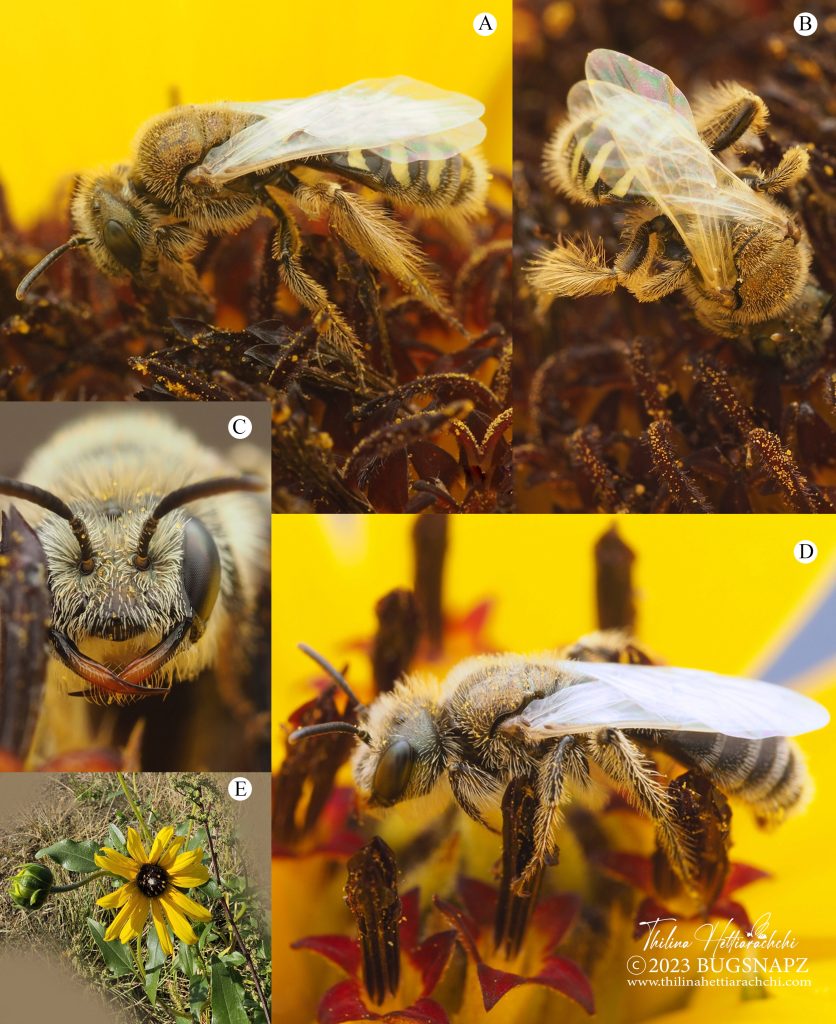
I also came across another Perdita, Perdita albipennis Cresson, 1868. This particular bee is often referred to as the white-winged fairy bee due to its distinct whitish wings. These are sunflower specialists. I photographed both male and female white-winged fairy bees on prairie sunflowers (Helianthus petiolaris) (Fig. 4).
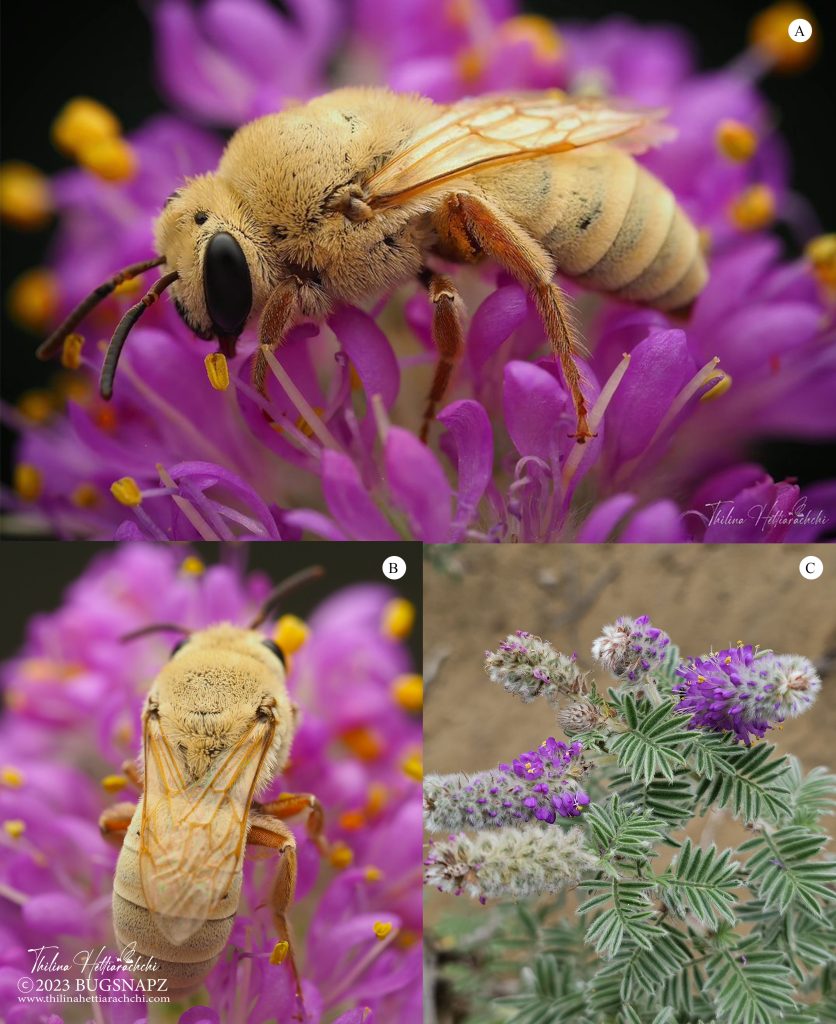
More importantly, I was able to check off one of my bucket-list species, Colletes wilmattae Cockerell, 1904 (Fig. 5). This species holds a special place in my heart, and I had a feeling that today might be the day I’d find it. Known for its stunning beauty, Colletes wilmattae is uncommon in Manitoba, a specialist, exclusively found on silky prairie clover, Dalea villosa. Theodore D. A. Cockerell (1904) named the bee in honour of his wife, Wilmatte Porter Cockerell. Silky prairie clover is a captivating plant, considered a species at risk. Interestingly, it can also be found on active dunes. In Manitoba, thriving populations of both the plant and bee are sparse, with Spruce Woods Provincial Park hosting some of the best habitat for them to flourish (COSEWIC 2000).
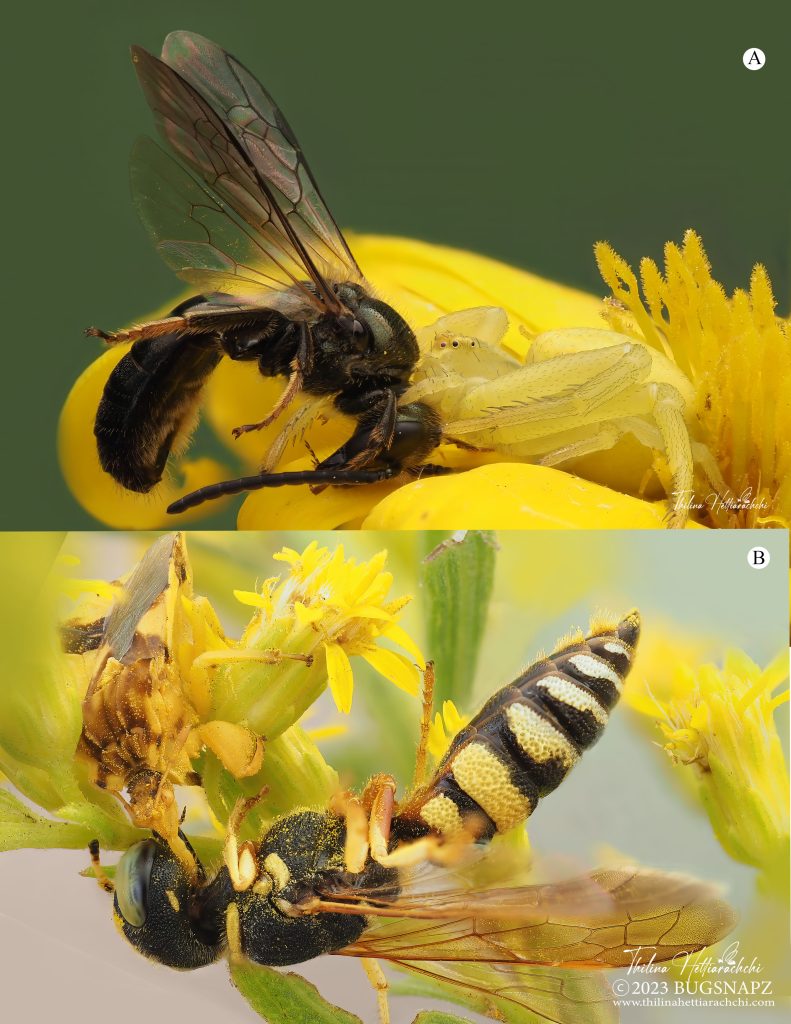
Another captivating sighting was a tiny male bee, Lasioglossum (Dialictus) nigroviride captured by a goldenrod crab spider, Misumena vatia, on a yellow flower of hairy false goldenaster, Heterotheca villosa (Fig. 9A). The spider’s remarkable camouflage, blending seamlessly with the colour of the flower, initially went unnoticed.
During our journey, I also documented several other bee species:
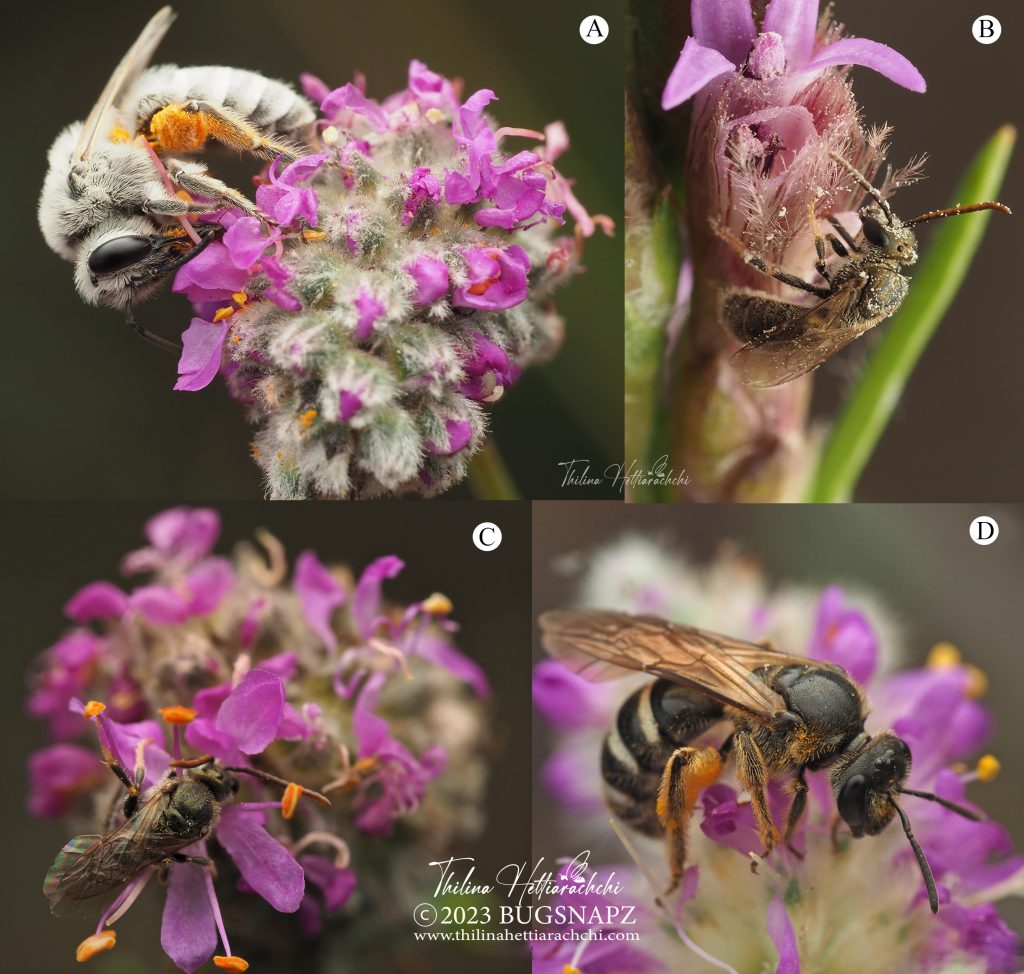
- Female Susanne’s cellophane bee, Colletes susannae (Swenk, 1925) on Dalea purpurea (Fig. 6A). Myron H. Swenk named this bee for his mother, Susanne.
- Two male Lasioglossum (Dialictus) spp. observed on Liatris punctata and Dalea purpurea flowers (Fig. 6B & C).
- Female Lasioglossum (Lasioglossum) sp. spotted on Dalea villosa (Fig. 6D).
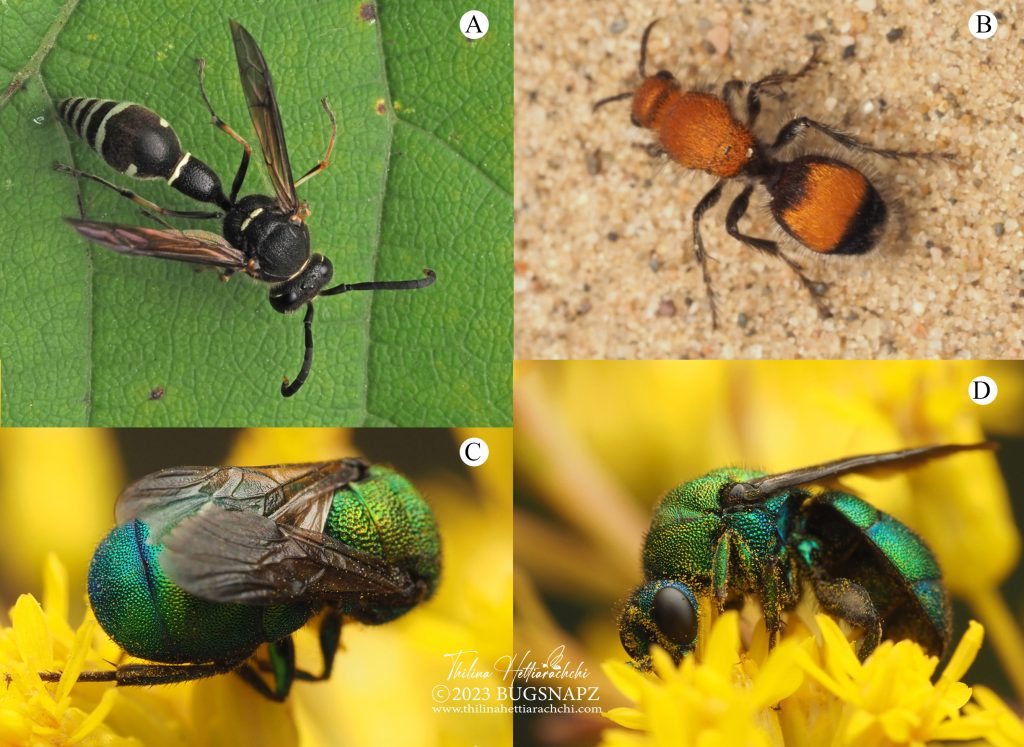
I encountered numerous velvet ants, both males and females, actively traversing the sandy prairie trails and dunes. Due to their constant, bustling activity, capturing them on camera proved to be quite challenging. Most probably, they all belonged to same species. However, I managed to snap a photo of Dasymutilla bioculata (Cresson, 1865) (Fig. 7B). Amidst the abundant flowering Solidago rigida plants along the way, it was impossible to miss the sight of a stunning, emerald-coloured wasp flying around the yellow blooms. These elegant insects turned out to be cuckoo wasps from the genus Hedychrum (Fig. 7 C & D). Additionally, I spotted a potter wasp resting on a leaf. Commonly known as the cross potter wasp, this Eumenes crucifera Provancher, 1888 (Fig. 7A), was a nice addition to my species checklist.
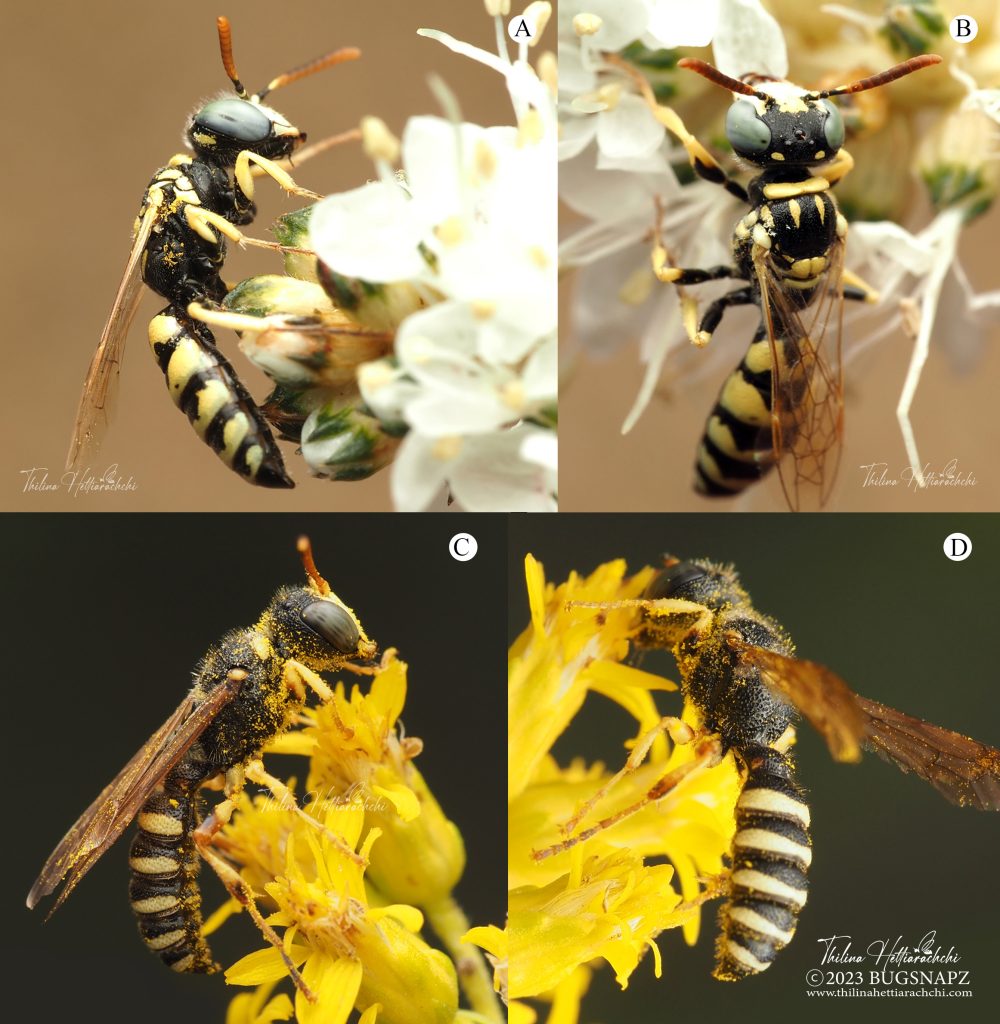
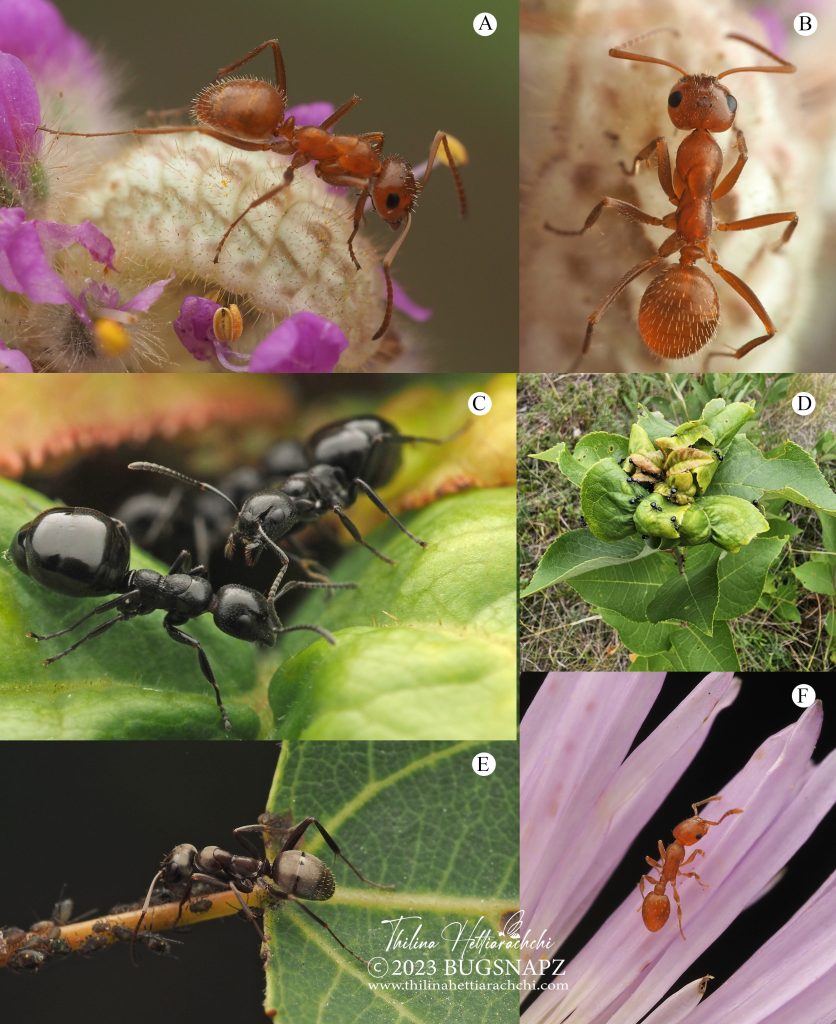
Bradley’s field ant, Formica bradleyi (Wheeler 1913), a sand-dune specialist was abundant in the park. I noticed this ant in association with lycaenid caterpillars, which were feeding on petals of Dalea villosa (Fig. 11A & B). I found it curious while observing these caterpillars, that I couldn’t locate any butterfly species whose larvae develop by particularly feeding on Dalea villosa, based on the literature I consulted. Taschenberg’s odorous ants, Dolichoderus taschenbergi, were also commonly spotted on some of Prunus plants (Fig. 11C & D).
In addition, the following ant species were recorded:
- Formica sp. ants were recorded associated with aphids on aspen leaves.
- A few doubtful acorn ants, Temnothorax ambiguus (Emery, 1895), were spotted on Erigeron flowers. This was the smallest species I documented that day, measuring only 2 mm.
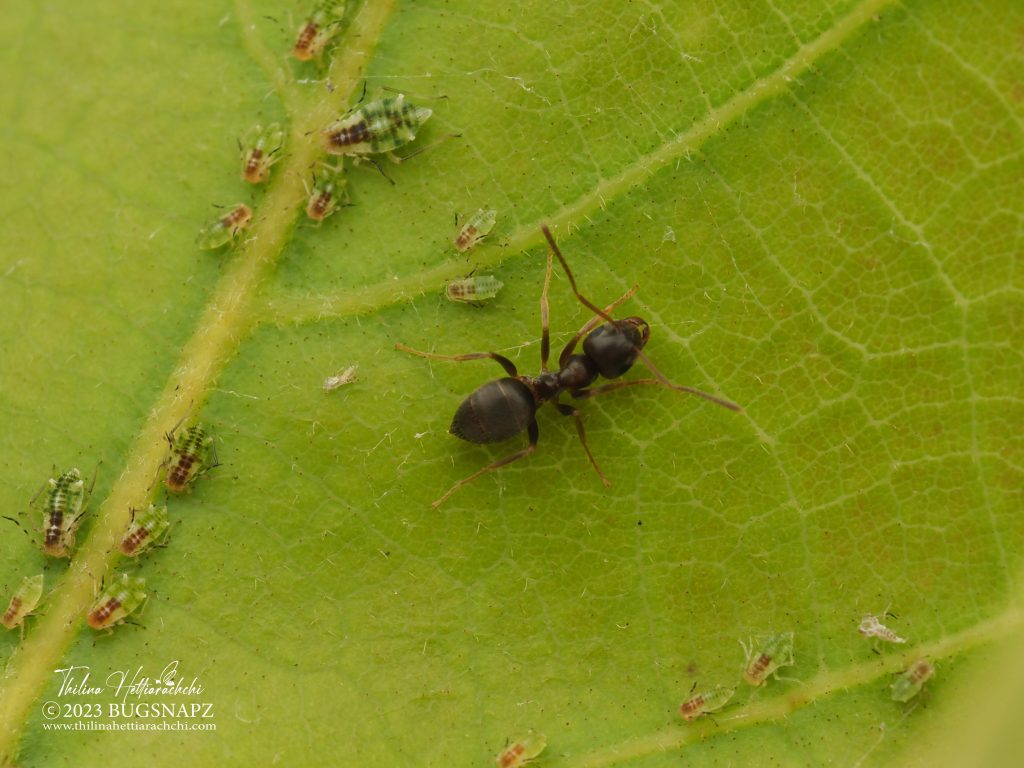
- Lasius sp. ants were recorded associated with aphids on young Salix leaves (Fig. 11).
Around 3.45 PM, we began the long trek back to the parking lot and the two-hour drive back home. I have presented here the species that I observed and photographed, but I no doubt missed dozens of others while walking along the trails. At least 176 species of Apoidea are documented from the park in my institutional collection, the J.B. Wallis / R.E. Roughley Museum of Entomology (Gibbs 2024). With each step, I felt a sense of gratitude for the opportunity to witness and document these wonders of nature, and I eagerly anticipate the discoveries that await us in the seasons to come.
Acknowledgements
Special thanks are owed to Dr. Jason Gibbs and Dr. Robert Wrigley for their invaluable contributions to refining this article through editing and providing insightful comments. Additionally, my appreciation extends to everyone who aided in identifying certain species through the photographs I uploaded to the iNaturalist website.
References
COSEWIC 2000. COSEWIC assessment and status report on the hairy prairie-clover Dalea villosa var. villosa in Canada. Committee on the Status of Endangered Wildlife in Canada. Ottawa. vi + 22 pp.
Gibbs J (2024). J. B. Wallis / R. E. Roughley Museum of Entomology. Version 1.0. University of Manitoba. Occurrence dataset. https://doi.org/10.5886/hgagiy
I actually wanted to post a simple comment to thank you for all the magnificent tips and tricks you are giving out at this site. My particularly long internet lookup has at the end been paid with brilliant facts to share with my family and friends. I ‘d say that most of us readers are undoubtedly fortunate to exist in a magnificent site with very many awesome individuals with beneficial principles. I feel very much blessed to have encountered the web page and look forward to plenty of more fun times reading here. Thanks again for a lot of things.